





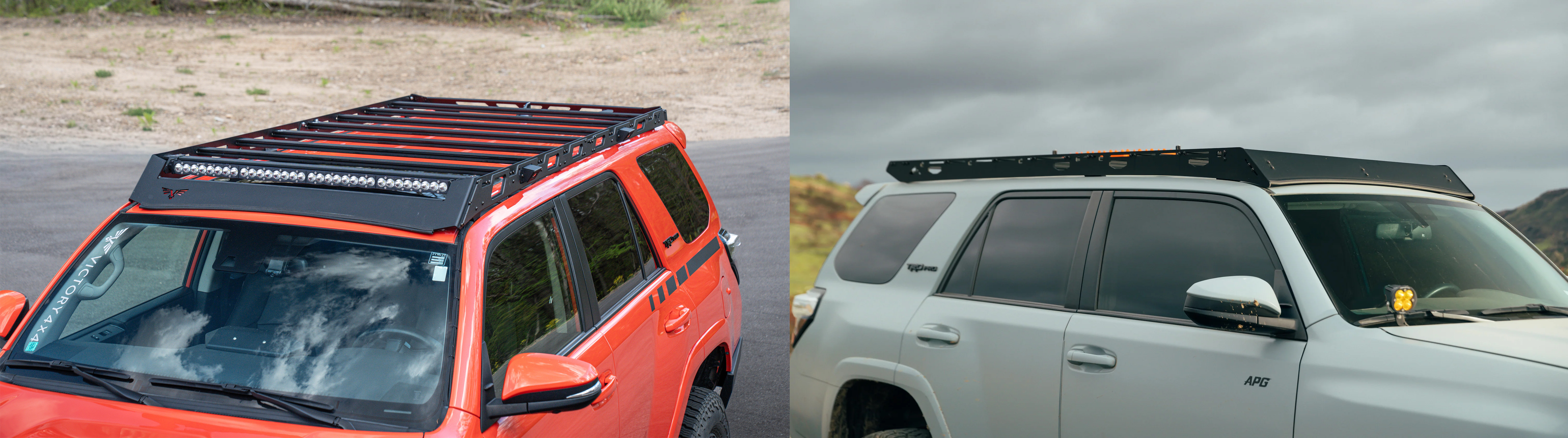
If you're shopping for a roof rack for your Toyota 4Runner, Lexus GX, Land Cruiser, or another supported platform, chances are you've come across both Victory 4x4 and Sherpa.
So why would we compare our roof rack to Sherpa?
Because you're already comparing them.
If you're reading this article, you've probably got multiple tabs open, watched a handful of YouTube videos, and you're trying to figure out which one is the better fit.
Rather than pretending those comparisons aren't happening, we'd rather be part of the conversation.
We'll do our best to be objective, point out where each rack shines, explain the tradeoffs, and give you the information you need to decide which one is the better fit for your build.
The truth is, Sherpa builds a quality roof rack. They've earned a strong reputation in the Toyota and Lexus communities, and for good reason.
At the same time, there are meaningful differences between the Sherpa Crestone and the Victory Evolution that are worth understanding before you spend over a thousand dollars on a roof rack.
Note: Throughout this article, we'll use pricing from the 5th Gen Toyota 4Runner because it's one of the most popular applications. The design philosophies discussed here generally apply across the other vehicle platforms offered by both companies, although pricing and some features may vary.
The good news?
Both are premium American-made roof racks.
At the time of writing, retail pricing for a 5th Gen Toyota 4Runner roof rack is:
Victory Evolution
$1,099 + $14.95 shipping
Sherpa Crestone
$1,559 + $65 shipping
That's roughly a $510 difference delivered.
Price shouldn't be the only factor when choosing a roof rack, but it's certainly part of the conversation.
The question becomes:
What do you get for the additional investment?
What They Have in Common
Before discussing the differences, it's worth recognizing how similar these racks really are.
Both offer:
One area where both companies deserve credit is their mounting systems.
Both Victory 4x4 and Sherpa offer some of the strongest roof rack mounting systems on the market. Whether you're carrying camping gear, mounting a rooftop tent, or loading the rack for an overland trip, both have earned a reputation for building strong, dependable platforms.
The differences between the two aren't about whether one is stronger. They're about the design choices each company made.
One of the biggest differences between these racks is how they attach to the vehicle.
Sherpa uses molded rubber mounting spacers that compress against the roof, creating a seal without requiring RTV or silicone during installation.
It's a thoughtful design that many DIY installers appreciate.
Victory Evolution uses vehicle-specific formed steel mounting brackets that are sealed with RTV during installation.
We've installed thousands of roof racks using this method, and it's one we've trusted for years.
Is avoiding RTV worth an additional $510?
For some buyers, it might be.
For others, spending a few extra minutes applying sealant during installation isn't a deciding factor.
Both Victory 4x4 and Sherpa use the same proven 10-series aluminum extrusion for their crossbars.
One difference is adjustability.
Sherpa allows a wider range of front-to-back crossbar adjustment.
Victory 4x4 allows approximately two inches of adjustment forward and two inches rearward from center.
For most owners, this won't be a deciding factor. Crossbars are typically installed once and left in place for years.
If you regularly change your rack configuration or have unique accessory mounting needs, Sherpa's additional adjustability may be worth considering.
Otherwise, both systems provide plenty of flexibility for camping, overlanding, and everyday use.
Sherpa machines their side rails from 1/4-inch aluminum.
Victory 4x4 Evolution uses a 3/16-inch structural aluminum side rail with a 3/16-inch bolt-on accent side panel.
The result is a thicker, more finished appearance while maintaining the strength customers expect.
Both are quality designs.
They're simply different approaches.
This is probably the biggest visual difference between the two racks.
Sherpa has a clean, understated appearance.
Even their logo reflects that philosophy with a simple mountain design that doesn't draw much attention.
Victory 4x4 Evolution takes a different approach.
The rear fairing and bolt-on accent side panels give the rack a more integrated appearance that follows the lines of the vehicle.
Some customers prefer a minimalist design.
Others want a rack that looks like it was designed as part of the vehicle.
Neither choice is wrong.
One of the most common questions we hear is, "Which roof rack is quieter?"
The honest answer is that there isn't a meaningful difference.
Both Victory 4x4 and Sherpa use a low-profile design that sits close to the roof, making them about as quiet as you can expect from a full-length aluminum roof rack.
If you're hearing wind noise, it's usually caused by what's mounted to the rack.
Light bars, rooftop tents, recovery boards, awnings, and other accessories generally have a much bigger impact on wind noise than the rack itself.
A roof rack is rarely the last modification someone makes.
As your adventures grow, you'll probably find yourself adding:
Both companies offer quality roof rack accessories.
Victory 4x4 has invested heavily in building a complete accessory ecosystem so customers can continue adding to their rack as their adventures evolve.
For some people, a roof rack is the only modification they'll ever make.
For others, it's just the beginning.
Sherpa focuses on roof racks and roof rack accessories.
Victory 4x4 takes a broader approach.
In addition to roof racks, we design and manufacture:
One advantage of that approach is consistency.
As your vehicle evolves, your accessories continue to match. The styling, finishes, and overall design language carry throughout the build.
If you're only shopping for a roof rack, this may not matter.
If you're planning to build your vehicle over the next several years, it's something worth considering.
If this is your first vehicle modification, don't let it intimidate you.
A roof rack is one of the best DIY projects you can tackle.
Basic hand tools, a free afternoon, and maybe a friend to help lift the rack are about all you need.
At Victory 4x4, we've invested heavily in detailed installation instructions because we'd rather help customers succeed the first time than answer avoidable questions later.
That's really what this comparison comes down to.
Sherpa includes several thoughtful features:
Those are all legitimate advantages.
The question is whether they're worth roughly $510 more for your build.
For some customers, the answer will be yes.
For others, they'd rather put that money toward skid plates, recovery gear, camping equipment, or fuel for their next adventure.
Neither answer is wrong.
Choose the Victory 4x4 Evolution if you:
Choose the Sherpa Crestone if you:
If you've made it this far, you should have a pretty good idea which roof rack fits your priorities.
If you're looking for a clean, minimalist roof rack and don't mind spending more for features like rubber roof seals and greater crossbar adjustability, Sherpa is a great option.
If you're looking for a premium roof rack that saves you about $510 while offering a complete ecosystem of products that can grow with your build, the Victory 4x4 Evolution is worth a serious look.
Either way, you're buying a quality American-made product.
If you're still researching, keep comparing. Read reviews. Watch installation videos. Look through customer photos. The more informed you are, the more confident you'll be in your decision.
If you're planning to build more than just a roof rack, you may also find these guides helpful:
What Should I Modify First on My New 4Runner?
Steel vs. Aluminum vs. Hybrid Bumpers
How to Choose Rock Sliders
How to Safely Carry Extra Fuel
Our goal isn't just to help you choose the right roof rack.
It's to help you build a vehicle that's ready for wherever your next adventure takes you.
Brian Meyers
President / CEO
